There is a truck in a driveway off Highway 82 right now that hauls a loaded stock trailer to the sale barn on Saturday morning, then runs I-35 south to a job in Denton County every weekday after. Same truck both times. Not the same job.
That is the whole problem with picking truck tires in Gainesville TX. Most advice assumes your truck is a work truck or a commuter, and a lot of half-tons around Cooke County are both. When somebody asks whether to stay P-metric or step up to LT, the honest answer starts with a question back: what is the heaviest thing this truck does regularly?
One thing first. This article is about the tires on the truck. The tires on the trailer behind it follow different rules entirely, and we wrote about those separately in why trailer tires time out before they wear out.
Your Truck Has Two Jobs, and the Tires Only Get to Pick One
A tire does not average things out. On the day the trailer is hooked up, it is either rated and inflated for that weight or it is not, and the easy weekday miles buy it no credit.
So the decision usually follows the heavier job. That does not automatically mean LT tires, and it does not mean the biggest, stiffest tire on the wall. It means load gets settled first, and comfort, noise and fuel get sorted out inside whatever options are left.
LT vs P-Metric Tires: What the Letters Actually Mean
Look at your sidewall and find the size. A P means a P-metric tire, a passenger-type design. LT means a light truck tire. A number and no letter usually means a Euro-metric or hard-metric tire, a different standard again.
Here is the part that surprises people: those letters are not a quality grade. LT is not the premium version of P. They are two engineering standards built around different assumptions. LT construction carries heavy loads at higher air pressures. P-metric construction is built around passenger-vehicle ride and handling, and it can absolutely be the correct tire for a light truck, because plenty of light trucks leave the factory wearing them.
What matters is not which letter sounds tougher. It is how much weight the tire carries at the pressure you actually run.
The 1.10 Rule Nobody Mentions at the Counter
This one is worth reading twice, because it changes the math on almost every half-ton in Cooke County.
When a P-metric tire is installed on a light truck, meaning a pickup, SUV, van or minivan, its load rating is reduced by a factor of 1.10. Not a shop rule of thumb. It is mandated by Federal Motor Vehicle Safety Standards 571.120, on the expectation that passenger-type tires see rougher service on a truck than under a sedan.
Nitto’s technical bulletin on replacing tires on light trucks works the example out. A P265/75R16 114 carries a maximum of 2,601 lbs at 35 psi according to the Tire and Rim Association load tables. Put that same tire on a light truck at that same 35 psi and it is only accommodating 2,365 lbs. Same tire, same air, several hundred pounds less capacity, purely because of what it is bolted to.
Nexen’s safety bulletin runs the math on another size. A P265/70R17 113S rated for 2,535 lbs at its maximum 44 psi is derated to 2,305 lbs on a light truck. That truck’s manufacturer required 2,470 lbs front and 3,005 lbs rear from the original LT265/70R17 Load Range E. The P-metric tire could not get there at any pressure it was allowed to run.
That is the real reason “just put P-metrics on it, they ride nicer” is sometimes wrong. Not because P-metric tires are bad. Because the number on the sidewall is not the number you get.
Load Index and Load Range Are Not the Same Number
These two get mixed up constantly, and the confusion costs people tires.
Load index is the two- or three-digit code right after the size, like the 114 in P265/75R16 114. It maps to a maximum weight the tire can carry at a specified pressure.
Load range is the letter, most often C, D or E on light truck tires. It describes how much air pressure the casing is built to hold, which is what lets a tire reach a high capacity at all.
The trap is treating load index as a scoreboard where the bigger number wins. The guidance published alongside the Tire and Rim Association tables is blunt: load index may not be used on its own to judge a replacement tire, because tires with the same load index may require substantially different inflation pressures, and an equal or greater load index does not always mean equal or greater capacity at every pressure.
One more wrinkle if you run a dually. Some LT tires carry two load indexes separated by a slash, like LT235/85R16 120/116S. The first applies when the tire is mounted as a single, the second in a dual pair, where capacity drops by 9% to account for the crown of the road.
Why an LT Tire Wants More Air Than the Tire It Replaced
If there is one idea here worth carrying out to your truck, it is this one.
Size for size, LT tires require higher air pressure to carry the same load as a P-metric tire. Not the same pressure. Higher. To carry what a P265/75R16 114 carries at 35 psi, an LT265/75R16 has to be inflated to 50 psi. And here is the part that stops people cold: Load Range C, D and E all require that same 50 psi to do it. Stepping up the load range does not let you run less air for a given load.
Nitto puts it about as plainly as a technical bulletin ever puts anything. LT tires do not offer any benefits of being heavy duty when underinflated.
So the failure we see at the shop is not buying the wrong tire. It is buying an LT tire, believing you have upgraded, then still running the door-jamb pressure your P-metrics used. That truck now carries less than before, and runs hotter doing it.
Hotter is not a figure of speech. Nitto’s bulletin includes thermal camera photos of a loaded LT tire at 30 psi cold beside the same tire at 50 psi cold, on a scale running from 95°F to 122°F, and the underinflated one is visibly hotter across the sidewall. Their warning: failing to raise pressure to meet the vehicle’s load requirement results in tire fatigue and eventual failure from excessive heat buildup. Nexen describes where that ends. Sidewall flex from underinflation or overloading builds heat, leading to discoloration, separation of the tire’s inner layers, and eventually tire separation or a blowout. Misapplication is also not a warrantable condition, which is a polite way of saying nobody is covering that tire for you.
That matters more here than in a milder climate. A North Texas August, a loaded trailer and I-35 at highway speed stack heat on heat, and the tire absorbs all three.
Loaded on Saturday, Empty on Monday: Setting Pressure for Both
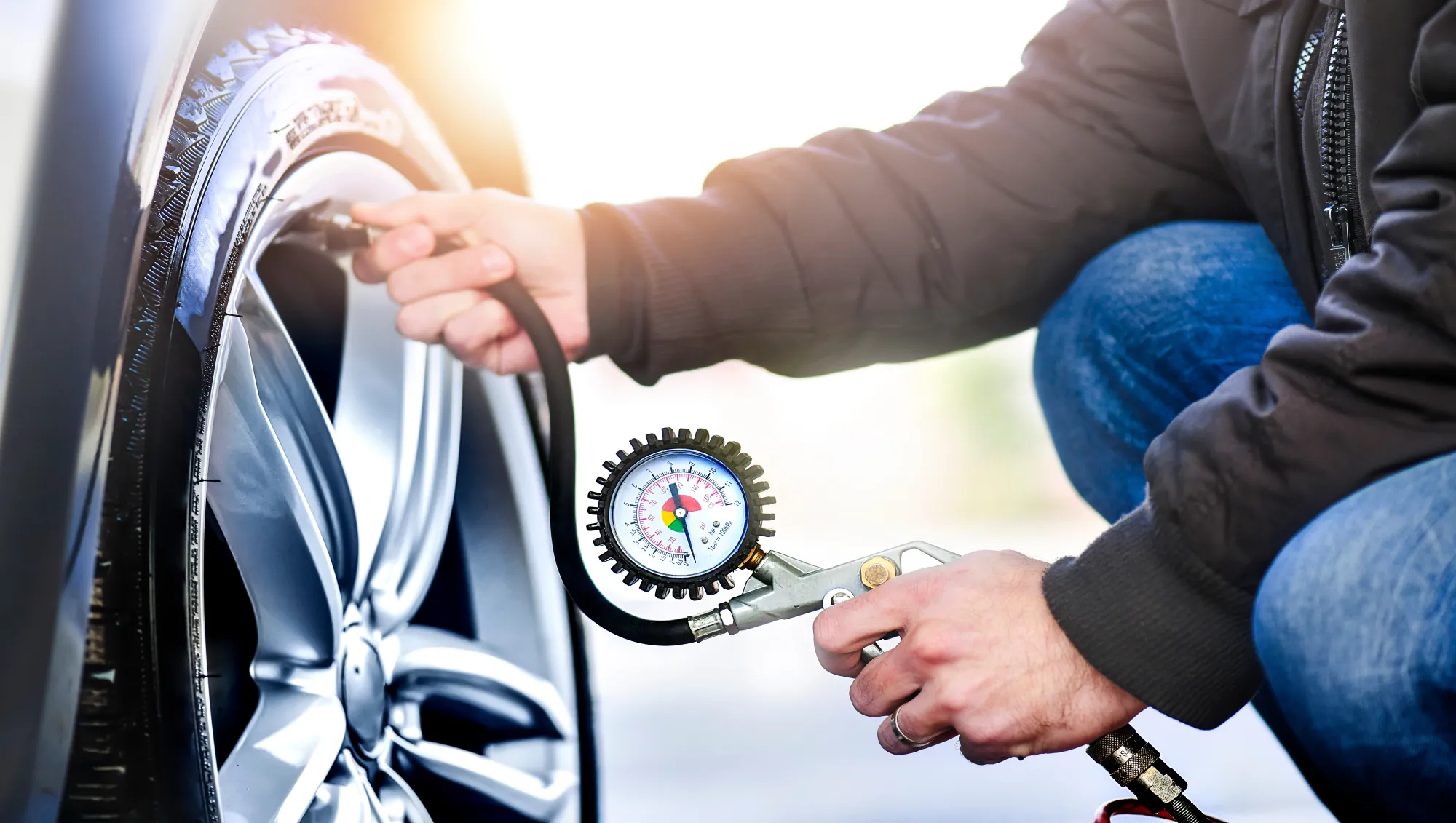
Start at the tire information placard, the sticker on the driver’s door edge or jamb. That placard, not the sidewall, is the reference for your truck’s recommended cold inflation pressure and size. The maximum pressure printed on the sidewall is a property of the tire, not a recommendation for your vehicle, and treating it as one is a common and expensive mistake. For the broader case, proper tire pressure matters for safety and performance on every vehicle you own, not just the towing one.
If you changed size, or changed from P-metric to LT, the placard no longer tells the whole story. The correct pressure for the new tire at your load comes out of the load and inflation tables for that size and load range. It is a lookup, not a guess, and it is worth having your tire shop in Cooke County handle before you hook up to anything.
From there, the routine for a two-job truck looks like this:
- Know two numbers: your everyday pressure and your towing pressure. Write them inside the glove box door.
- Air up before you load, not after you are hooked up and running late.
- Set pressure cold. The Tire and Rim Association defines cold inflation pressure as pressure read at outside temperature with no buildup from driving, meaning parked at least three hours or driven less than a mile.
- Drop back to your everyday pressure after the haul if the tables call for a meaningful difference.
- Check all four with a real gauge. A stiff LT sidewall can look fine at a pressure that is badly low for the load.
That third point catches a lot of folks. Air up in the afternoon after driving in from Muenster and the tires are hot, so the gauge reads high and you set them low without knowing it. The morning reading tells the truth.
One honest exception. Plenty of work trucks and small fleets here are never really empty. With tools, a welder and a bed of material in there all week, your “unloaded” pressure is closer to your loaded one than you would guess.
The Trade-Offs of Stepping Up: Ride, Noise, and Fuel
Nobody should sell you LT tires without telling you what they cost you in comfort, so here it is.
Because LT tires need higher pressure to do their job, they ride firmer. Nitto says this outright: due to the higher psi requirements of LT tires, they may not suit replacing original P-metric tires because of the ride harshness that results. On a truck that spends five days a week on I-35 and one Saturday a month behind a trailer, you feel that firmness far more often than the extra capacity.
Tread pattern matters too. A heavier, more aggressive light truck tire generally makes more noise at highway speed, and that noise rides along on every commute between Gainesville and Denton. If your towing is occasional and your load modest, a properly rated P-metric or a road-focused LT can beat the most aggressive thing on the rack.
Fuel is where pressure discipline pays you back whichever tire you choose. The U.S. Department of Energy reports that keeping tires properly inflated improves gas mileage by 0.6% on average and as much as 3% in some cases, and that underinflated tires cut mileage by about 0.2% for every 1 psi drop in the average pressure across all four.
How to Tell Which One Your Truck Needs
You can get most of the way to an answer in your own driveway:
- Read the placard. What size and pressure did the factory specify? If your truck came with LT tires, going to P-metric is a question you should not answer alone.
- Weigh the heaviest regular haul. Not the heaviest thing you ever pulled once. The one you do most months.
- Count the loaded days. A truck loaded three days a week is a different animal from one that tows twice a year.
- Check what the current tires actually carry at your actual pressure, remembering the 1.10 reduction if they are P-metric on a light truck.
- Be honest about the commute. Miles you drive empty are miles you spend paying for the ride and noise of whatever you picked.
Then bring it to us. Any replacement tire on a light truck must offer equal or higher load-carrying capacity than what the truck came with, and confirming that takes a load table and five minutes rather than a guess at the counter. You can also shop for tires by size or vehicle first and bring us a short list to check.
Talk It Through With Casey’s Tire & Brake in Gainesville
The LT vs P-metric tires question does not have one right answer for every truck in North Texas. It has a right answer for your truck, your trailer and your week.
We have that conversation with ranchers, contractors and commuters all the time, from Gainesville out to Whitesboro, Muenster, Valley View, Sanger and up toward the Oklahoma line. If you have been searching for a truck tire shop near you in Cooke County, we will pull the load and inflation numbers for the sizes you are considering, tell you honestly when stepping up is not worth the ride penalty, and set your pressures before you leave.
Tire pricing moves constantly with size, brand and availability, so rather than quote you a number that will be wrong by the time you read it, request a current quote and we will give you real figures for the exact tires that fit your truck and your towing.
Come see us before the next haul, not after the blowout on the shoulder of I-35.