
Ask ten drivers in Gainesville how often their vehicle needs an oil change and you will get ten numbers, most of them borrowed from a neighbor, a quick-lube sticker, or something half-remembered from a previous truck. Almost nobody gives the honest answer, which is that it depends on which of the two schedules in your owner’s manual describes the way you actually drive.
That is not a dodge. Your manual really does print two schedules, and the second one is written for conditions that describe a lot of Cooke County life. This post is not going to hand you a mileage number, because the right number belongs to your specific vehicle and lives in your specific manual. What it will do is show you how to find both schedules, how to score your own week against them honestly, and what dust, towing, and idle time are doing under the hood while you do it.
Your Manual Prints Two Schedules, and Most People Only Read One
Open almost any maintenance guide and you will find a main chart of services due at set mileages. Below or beside it, often in a shaded box or under a small numbered footnote, sits a second block. Toyota’s Scheduled Maintenance Guide labels it “Additional Maintenance Items for Special Operating Conditions.” Other manufacturers call it severe service, severe duty, or simply Schedule 2.
Here is the part people miss. That second block is not for a different vehicle. It is for a different week. Same truck, same engine, same oil, just driven in conditions that age the oil and load the filters faster than the base chart assumes.
AAA describes the same structure plainly: vehicles with mileage-based oil change intervals carry separate schedules for normal and severe service conditions, and for severe service you follow the more rigorous one outlined in your owner’s manual. The manual is not being vague. It is asking a question about your driving and waiting on your answer.
How to Find Both Schedules in Your Own Owner’s Manual
You do not need to be mechanically inclined to do this. Give it five minutes in the driveway with the glovebox open.
- Turn to the section called maintenance, scheduled maintenance, or scheduled servicing. It usually sits near the back, after the pages on warning lights.
- Find the main interval chart. That is schedule one, the base schedule.
- Now look for a second chart, a shaded panel, or a numbered footnote below the table. The headings to hunt for are “special operating conditions,” “severe service,” “severe duty,” or “Schedule 2.”
- Read the conditions list attached to it. That list, not the mileage, is the important part.
- If your glovebox booklet went missing years ago, the same maintenance guide is almost always a free download on the manufacturer’s owner site using your VIN.
One more line is worth copying down. Toyota’s guide tells owners to perform those additional services if you drive “primarily” under any of the special operating conditions indicated, and adds that if you drive only occasionally under those conditions, the extra services are not necessary. That word primarily is your scoring rule. The question is not whether you have ever pulled a trailer. It is whether pulling one describes your normal week.
Score Your Own Week Against the Severe-Service Conditions List
The published condition lists are refreshingly specific, which means you can check yourself against them instead of guessing. Technical Service Bulletin 94-1 from the Filter Manufacturers Council and the Auto Care Association collects the conditions most owner’s manuals treat as severe:
- Driving in dusty conditions, such as dirt or gravel roads
- Towing a boat or trailer, or carrying heavy objects on a roof rack
- Frequent idling for long periods, including stop-and-go driving in heavy traffic
- Sustained highway driving in hot weather
- Prolonged operation in extreme cold
- Driving steep hills or mountains on a regular basis
AAA’s version of the list is shorter and lands in the same place: primarily short trips of five miles or less, extremely hot, cold, or dusty climates, sustained stop-and-go driving, and carrying heavy loads or towing a trailer.
Two things stand out. TSB 94-1 is explicit that any one of those conditions can be enough to put a vehicle on the shorter schedule, so this is not a scorecard where you need three checkmarks. The bulletin also argues the labels themselves mislead people, because what manuals call “normal” is really closer to ideal, mostly long highway trips rather than around-town driving. A survey it cites found only about twenty percent of vehicles are regularly driven under those normal conditions, which puts four out of five drivers in the severe category. Better names for the two schedules, the bulletin suggests, would be ideal and average, since nobody likes to think of themselves as a severe driver.
What Cooke County, TX Driving Actually Does to a Vehicle
Now put that list next to the way people around here actually drive. The 2022 USDA Census of Agriculture counts 2,188 farms in Cooke County covering 513,278 acres, roughly 147,000 acres of cropland and just over 300,000 acres of pasture, at an average of 235 acres per farm. Livestock, poultry, and products make up 82 percent of the county’s agricultural sales, with grains the largest crop category. Getting between all of that means county roads, and plenty of them are gravel and caliche.
Then add the heat. Gainesville averages a high of 93 degrees in July and 94 in August, its two hottest months. A truck idling with the air conditioning running at a job site outside Muenster on an August afternoon is doing real work that the odometer never records.
Picture a few honest weeks:
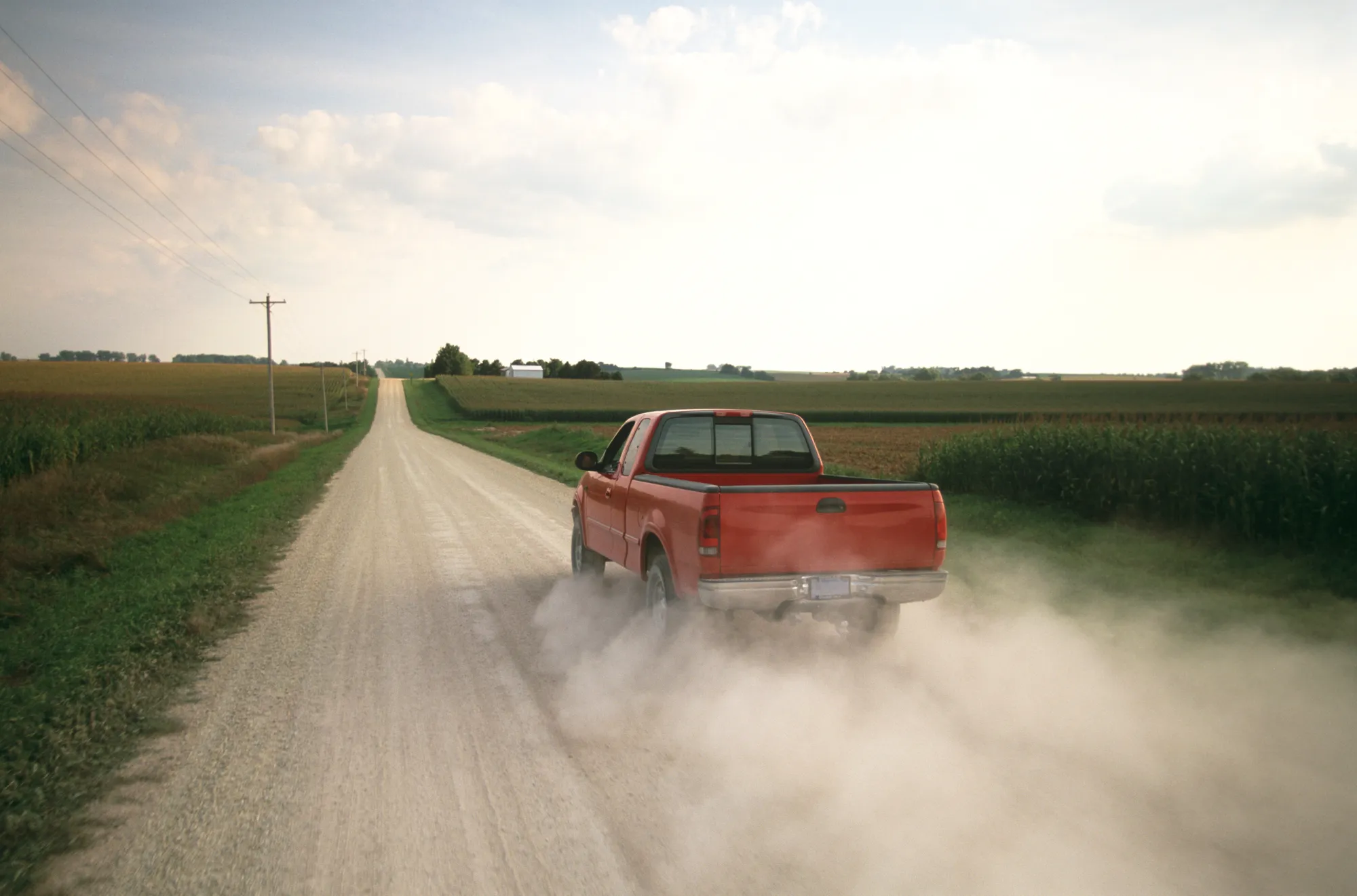
- A rancher runs a half-ton pickup down two miles of caliche county road twice a day to check stock, then hooks a gooseneck to the sale barn on Saturday. The odometer barely moves, while the conditions list flags two separate triggers.
- A contractor idles at a Valley View job site through a 94-degree afternoon, then drives ten miles home. Those idle hours appear nowhere on the dash mileage.
- A grain or hay hauler in late summer runs loaded in ninety-degree heat, with the last few miles on gravel. Towing, heat, and dust all stack up inside one trip.
- Someone commutes I-35 to Denton five days a week in a clean sedan with nothing behind it. That driver really is who the base schedule was written for.
If you live around Whitesboro, Muenster, Valley View, Sanger, or anywhere along the I-35 corridor up to the Oklahoma line, the odds are decent that at least one severe-service condition describes your ordinary week. That is exactly what a severe service oil change interval exists for, and it is why the right oil change for Cooke County, TX drivers starts with a conversation about your week rather than a sticker on the windshield.
Dust: Why the Air Filter Gets Escalated Too
Read the dusty-roads block in a manual closely and you will notice it is not only about oil. Under “Driving on dirt roads or dusty roads,” Toyota’s guide adds inspecting the engine air filter, inspecting ball joints and dust covers, inspecting drive shaft boots, inspecting steering linkage and boots, tightening chassis nuts and bolts, and re-torquing the propeller shaft bolt on four-wheel-drive vehicles.
That is the manufacturer telling you what dust actually threatens: the thing filtering your intake air, plus every rubber boot and joint underneath that grit works its way into.
The cabin filter takes it too. The same guide notes that heavy traffic, dirt roads, and dusty or desert areas can shorten cabin air filter life, and it gives you the symptoms to watch for, which are reduced airflow from the air conditioner and heater, or windows that fog easily on fresh-air mode. If your vents have gone quiet since harvest, that is a clue rather than a coincidence.
One honest note on engine air filters. The Department of Energy and EPA point out that on modern fuel-injected engines, replacing a clogged air filter does not improve fuel economy, though it can improve acceleration. So the reason to keep a filter clean on dusty roads is protection and drivability, not a mileage claim.
Towing Heat and Idle Time Are Load the Odometer Never Sees
Oil does not age by distance. It ages by what the engine did.
TSB 94-1 describes the mechanism without much romance. Oil picks up blow-by soot, raw fuel, and condensed moisture. Dirt finds its way into the crankcase and metal particles flake off internal parts and bearings. Meanwhile the additive package doing the real work, the detergents, dispersants, anti-oxidants, viscosity improvers, and corrosion inhibitors, gets used up. As the bulletin puts it, the oil does not wear out, but the additives do. The point of a change is to carry the contaminants out and put a fresh additive package back in.
That is also why the bulletin says the filter should be replaced with every oil change. Up to three-quarters of a quart of used oil stays behind in the filter when only the oil is drained, and it mixes straight back into the clean oil.
Towing adds more than heat to the oil. Manuals escalate driveline service too. Toyota’s towing block calls for replacing rear differential oil and transfer case oil on four-wheel-drive vehicles at the longer intervals, plus tightening chassis and body fasteners. If you tow hay, grain, stock, or a job trailer around Cooke County most weeks, those items belong on your radar right alongside the oil change, and so do the trailer tires carrying the load.
Your Dash Oil Life Percentage Is Not the Severe Schedule
Plenty of newer trucks show an oil life percentage, and it is tempting to treat that number as the final word. It is a useful input, but know what it is.
Monitors range widely. Some simply track distance driven since the last reset. Others run software that watches engine revolutions, temperature, and operating conditions. The newest use a sensor that reads the oil’s dielectric properties directly. According to Vehicle Service Pros, apart from those sensor-based systems, oil life monitors share one shortfall: they cannot directly measure the condition of the engine’s oil or detect contaminants in it. The simplest distance-only systems take no account of short trips, towing, or weather at all.
So if the gauge still reads healthy after a dusty harvest week of towing, that is the algorithm’s estimate, not an analysis of what is sitting in your pan. Use the monitor as one input and your manual’s conditions list as the other. When they disagree, the conditions list knows something the monitor does not.
When You Are Honestly Not Sure Which Schedule You Are On
Sometimes the answer is genuinely mixed. You tow in the spring and fall, run highway miles the rest of the year, and hit gravel a couple of times a month. Which chart applies?
TSB 94-1 answers that directly: if you do not know which kind of driving you do the most, use the shorter schedule. Given that four out of five vehicles fall outside true normal conditions, that is arithmetic more than an upsell.
And if you really are the highway commuter with a clean car and no trailer, the base schedule is genuinely yours. Follow it and stop worrying.
Bring Us the Manual and We Will Read It With You
You do not have to sort this out alone in your driveway. Bring the vehicle and the glovebox booklet to Casey’s Tire & Brake in Gainesville, TX. We will find both schedules with you, walk the conditions list against how you really drive, and look at what your oil, oil filter, and engine air filter look like right now rather than what a chart predicts. If you have also been finding spots on the driveway, our guide to identifying fluid leaks by color is a good place to start.
If you have been searching for an oil change Gainesville TX drivers can trust to match their actual week instead of a generic number, that is the conversation we want to have. We serve Gainesville and Cooke County, from Whitesboro and Muenster to Valley View and Sanger, and we look after the rest of the severe-service list too, from air filters to brakes to the tires taking the worst of those gravel roads. You can see what our oil change service covers before you book.
As for what any of it costs, we are not going to print a number here that goes stale before you read it. Parts and labor move. Ask us and we will give you a current one for your vehicle and your schedule.
Request a quote from Casey’s Tire & Brake and we will get you on the right schedule for the way you actually drive around Gainesville and Cooke County.