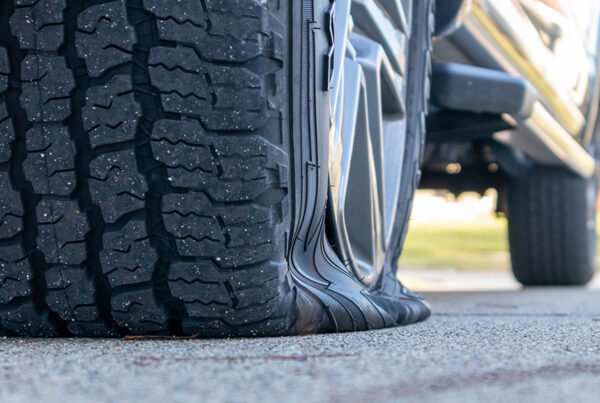

It usually happens on a Friday. You walk out to the truck, see cord showing through the shoulder of a rear tire, and remember the hay you promised to move Saturday morning. You call a tire shop in Gainesville, read the numbers off the sidewall, and hear the four words nobody wants on a Friday: “We can order that.”
That answer sounds like a delay. Most of the time it is not. There is a real process behind those words, and once you understand it you can walk up to the counter with the right information and get your set mounted faster than the person who showed up guessing.
Our team at Casey’s Tire & Brake has this conversation several times a week with drivers from Gainesville, Muenster, Valley View, and the rest of Cooke County. Here is what happens between “I need tires” and “your truck is on the lift,” and how to keep that gap short.
Why your size might not be sitting on the rack at any tire shop in Gainesville TX
Start with the math nobody sees from the customer’s side of the counter. According to Modern Tire Dealer, unique tire sizes in the U.S. market went from 157 in 1983 to 237 in 1993, 340 in 2003, and 588 by 2012, a 275 percent increase.
And a size is not one product. The same publication points out that one popular size can exist in a whole family of versions: the Continental ContiProContact has been offered in five different 245/40R18 variants, the Michelin Latitude Tour HP in six different 255/55R18 variants. Same numbers on the sidewall, different tires underneath.
So “do you have a 265/70R17” is not really one question. It is a question about size, brand, tread pattern, load range and speed rating, plus whether the vehicle needs the original-equipment version or a replacement version.
No shop in Cooke County, or anywhere else, can rack all of that. Modern Tire Dealer describes the trade plainly: stocking every variant risks slow moving or unmoving inventory that ties up cash, so dealers build their assortment from local vehicle registrations, sales history, and who actually walks through the door. That is why a good tire shop in Gainesville TX keeps deep stock in the sizes this county drives, which around here means half-ton and three-quarter-ton pickups, work vans, SUVs, and trailer sizes, and orders the rest. Local traffic sets that assortment, not a national average.
The scale is part of it. The U.S. Tire Manufacturers Association projected 330.3 million total U.S. tire shipments in 2026, including 218.3 million replacement passenger tires and 37.1 million replacement light truck tires.
So “we can order that” is the normal answer, not a sign the shop is short on tires. It means your vehicle wears something more specific than average.
What the placard and the sidewall already decided for you
Before anything gets ordered, the vehicle narrows the field itself. Two places carry that information, and both are free to read.
The first is the placard. Federal standard 49 CFR 571.110 requires every vehicle to carry a “Tire and Loading Information” label listing the original tire size, the spare, the manufacturer’s recommended cold inflation pressure for front, rear, and spare, the vehicle capacity weight, and the seating capacity. The rule puts it on the driver’s side B-pillar, or on the rear edge of the driver’s door if that spot will not work, and requires it to be legible, visible, and prominent.
Open your driver’s door and look. That label is the factory’s own statement of what belongs on the vehicle.
The second is the sidewall of the tire you have. The Tire Industry Association explains the code: a leading “P” means P-metric passenger, “LT” means light truck, “ST” means special trailer, and no leading letter means Euro-metric, which can carry a different load capacity than the P-metric equivalent of the same numbers. After the size comes the service description, where the two or three digit load index is the maximum load the tire carries at the speed its speed symbol indicates.
Those prefixes matter more than almost anything else on the tire. “265/70R17” and “LT265/70R17” are two different orders, and only one is right for a truck that tows.
While you are down there, find the DOT tire identification number. The Tire Industry Association notes that the last four digits are the build date: the first two the week, the last two the year, so a code ending in 2910 means week 29 of 2010. That is worth knowing if your weekend plan involves a spare that has hung under the bed since the truck was new.
Why trading down a load range to get something in stock is a bad deal
Here is the offer that tempts everybody in a hurry. Your size is not on the rack, but something with the same numbers is. On a car that is often fine. On a light truck or a trailer it frequently is not, and the sidewall is where you find out.
For tires other than passenger car tires, which includes LT and ST sizes, 49 CFR 571.119 requires the sidewall to carry the letter designating the tire’s load range and the maximum load rating spelled out as “Max load single ___ kg ( lb) at ___ kPa ( psi) cold.” That stamp is the honest limit on that tire at that pressure.
If your three-quarter-ton pickup came on a load range rated for a given weight at a given cold pressure and the in-stock option is stamped for less, you have not bought convenience. You have bought a lower ceiling on the work the truck can do, and you learn that the first time you hook onto a loaded gooseneck.
If you run DOT-regulated trucks, the rules are explicit. Under 49 CFR 393.75, a vehicle may not be operated with tires carrying weight beyond the load marked on the sidewall. That section also sets a minimum tread groove depth of 4/32 of an inch on steering-axle tires for buses, trucks, and truck tractors and 2/32 of an inch elsewhere, and prohibits running tires with ply or belt material exposed, with tread or sidewall separation, or with a cut deep enough to expose the belts. Those are the numbers an inspector uses.
Waiting a day for the correct load range beats driving off today on something the vehicle will out-work. If you are weighing that, our post on P-metric or LT truck tires walks through how towing changes what should go on your truck.
What to tell the counter so you order tires by size correctly the first time
Most repeat orders happen because the first call was missing one detail. To order tires by size and have the right set show up, bring all of this:
- The full size off the placard or the sidewall, including the prefix. LT, P, ST, or nothing at all is part of the size.
- The load range letter, if the tire has one.
- Year, make, model, and drivetrain. Two trucks with the same badge can wear different original fitments.
- What you tow or haul, and roughly how heavy. A stock trailer, a skid steer, and an empty bass boat are three different answers.
- What your roads look like. Gravel county roads and pasture gates ask for something different than a daily commute.
- Whether you want all four or a pair, and whether the vehicle is all-wheel drive.
- Your real deadline. Saturday at daylight is a different order than “sometime next week.”
That last one changes the whole approach, and people leave it out constantly. If we know the truck has to pull Saturday, we look at what can be here in time first and talk options second.
How the order actually gets here
Here is the part that surprises people. Wholesale tire distribution in this country is quick. American Tire Distributors, the largest wholesale tire distributor in North America, runs more than 100 distribution centers plus five regional distribution centers and offers same-day and next-day delivery on roughly 90,000 tire SKUs. That is the machinery behind “we can order that.” For a common light truck or passenger size, a set that is not on our rack this morning is often on the truck tonight.
So when you search for a tire shop near you and the answer is “tomorrow” instead of “right now,” tomorrow is usually literal. The timeline stretches at the edges of the catalog: specialty sizes, low-volume performance fitments, some ST trailer sizes, and anything on a lifted truck running an unusual combination. When that is your situation, the shop should give you a realistic day, not a hopeful one.
Gainesville sits in a good spot for this. The county seat of Cooke County, population 17,394 at the 2020 census, sits where U.S. Route 82 crosses Interstate 35, about 65 miles north of Fort Worth and roughly seven miles from the Oklahoma line. Being on that corridor is why freight moves through here on a normal schedule instead of an occasional one.
Planning the wait around a haul or a run up I-35
While the order is in transit, the honest question is whether the vehicle is safe to drive.
That is not a call you have to make on your own. Bring it by and let someone look at it. There is a real difference between tread worn thin and a sidewall with cord showing or a bulge in it, and only one of those is a park-it situation. Our post on tire plug versus tire replacement covers where that line falls on a damaged tire.
A few practical moves for the in-between days:
- If you are on the spare, check its pressure against the placard and check its date code. A spare that has never touched the ground can still be old.
- Keep the load off. Park the trailer until the new set is on. Weight is what turns a marginal tire into a failure.
- Watch the dash, but do not lean on it. Federal standard 49 CFR 571.138 covers vehicles rated 10,000 pounds or less and requires the low pressure light to come on within 20 minutes of a tire falling 25 percent below the recommended cold pressure. That is late by design, and owner’s manuals must say the system is not a substitute for keeping up with your pressures by hand.
- Book the install slot when you place the order, not when the tires land. Tire installation in Cooke County gets busy on Friday afternoons and Saturday mornings for the same reason your tire failed then.
If the trailer is the problem rather than the truck, remember trailer tires age out on a different clock. Our post on why trailer tires time out before they wear out is worth five minutes first.
The extras worth deciding when the order is placed
A few things ride along with a tire job. All of them are easier to settle while the order is being written than while your truck is in the air.
- TPMS. Sensors have batteries and service kits have rubber parts. If the vehicle has a monitoring system, ask whether sensors or seal kits belong in the job.
- Valve stems. On a non-TPMS wheel, new stems with a new set head off a slow leak a month later.
- Alignment. New tread on a vehicle that is out of alignment starts wearing wrong immediately. If the old set wore unevenly, that is your answer.
- Matching. On all-wheel drive, and across a pair of work trucks, matching the set matters more than grabbing whatever is closest.
What it costs, and where to get today’s number
You will notice this post has not named a figure anywhere. That is on purpose. Tire pricing moves with the market, brands run programs that start and stop, and parts and labor change. A number typed into a blog post would be wrong within weeks, and a wrong one is worse than none.
So get a live one. Tell us what you drive and what you need, and we will quote your actual set. Start with our Get a Quote page or call the shop, and if you want to browse fitments first, Shop for Tires lets you search by size or by vehicle.
Let’s get the right set on your vehicle
You should be able to buy tires in Gainesville without it turning into a guessing game, and “we can order that” is not a brush-off. It means your vehicle wears something specific, and the right set is one logistics step away instead of a compromise sitting on the rack.
Read your placard, read your sidewall, tell us your deadline, and let us handle the rest. Schedule an appointment with our team at Casey’s Tire & Brake here in Gainesville, or call and we will get your order started today.