Around here, half the trailers on the road spend most of the year parked. The hay trailer works hard for a few weeks in June and then sits behind the barn until spring. The bass boat goes to Lake Ray Roberts a handful of weekends and comes home. Those tires can look almost new and still be worn out, because a trailer tire ages on a calendar whether or not the wheels turn.
Tread depth is the wrong thing to trust on a trailer
Most people judge a tire the way they judge a car tire: look at the tread, see plenty of rubber, move on. That works when a vehicle drives enough to wear tires out on a normal schedule. It fails badly on a trailer.
A trailer tire usually reaches the end of its safe service life long before the tread reaches the end of its depth. The rubber hardens, the sidewall starts to check and crack, and the internal structure gives up while the tread still measures fine. General guidance is to consider replacing trailer tires every three to five years even when there is plenty of tread left, because trailers sit unused and develop flat spots, sidewall cracking and dry rot before wear ever becomes the issue.
- Deep tread on an eight-year-old boat trailer tire is a warning sign, not a good sign
- Age and mileage are independent of each other
- A tire that looks perfect from ten feet away can be brittle at the sidewall
What the ST on the sidewall actually means
Look at the size stamped on a trailer tire and you will usually see it start with the letters ST. That stands for Special Trailer, and it is a different animal from the P-metric tire on your car or the LT tire on your work truck.
An ST tire is built with a stiffer sidewall because its job is carrying vertical weight and resisting sway, not gripping through corners or steering. Nothing on a trailer steers and nothing on a trailer brakes the way a car does, so the engineering priorities are different. That is also why swapping in a passenger car tire because it was cheap and available on the shelf is a poor trade. It is not built for the load pattern a trailer puts on it.
- ST means Special Trailer, and it is a category, not a brand
- Stiffer sidewalls handle vertical load and reduce sway
- A passenger car tire is not a substitute for an ST tire
Load range and ply: reading the numbers on the sidewall
The load range letter is the other thing on the sidewall worth knowing. It tells you how much weight the tire is rated to carry at its rated cold inflation pressure, and it replaced the old ply-count language that people still use out of habit.
The letters line up with the legacy ply ratings this way: Load Range B equals a 4-ply rating, C equals 6-ply, D equals 8-ply and E equals 10-ply. Above that, F, G and H equal 12-, 14- and 16-ply. Nobody is actually stacking that many layers of fabric in a modern tire, but the rating still describes the capacity.
Alongside the load range you will find a load index number, which states the maximum weight the tire can carry at its recommended inflation pressure. As an example, a 205/75R14 trailer tire with a load index of 100 is rated to carry 1,764 pounds. Multiply that across the number of tires on the ground and you have the honest ceiling for what that trailer should haul, including the weight of the trailer itself.
- Match or exceed the load range on the trailer’s placard, never go below it
- Multiply the per-tire rating across every tire on the axles
- Remember that the trailer’s own weight counts against that total
The speed rating most ST tires carry
This one surprises people, and it is worth knowing before your next run down I-35. Special Trailer tires built before 2015 generally carried a maximum operating speed of 65 miles per hour, with no marking on the sidewall to tell you so. Newer ST tires may carry an actual speed letter instead: J means 62 mph, L means 75 mph and M means 81 mph.
So if your trailer is a few years old and rolling on its original tires, there is a real chance those tires were engineered around 65 mph, and traffic on I-35 between Gainesville and Sanger routinely moves faster than that. Running a tire above the speed it was designed for builds heat, and heat is what takes trailer tires apart. Look at your sidewall and find out which set you have before you assume you can keep pace with the left lane.
- Check the sidewall for a speed letter before your next long haul
- No letter on an older ST tire generally means a 65 mph design
- Heat from overspeeding is a leading cause of trailer blowouts
Why sitting still is harder on a tire than towing
Here is the part that explains almost everything about trailer tires. A tire that rolls regularly flexes, and that flexing works the tire’s protective compounds out to the surface where they can do their job against sunlight and ozone. A tire that sits still does not flex, so those compounds stay locked inside while the outside of the tire takes the beating.
And it is a beating. During storage, a trailer’s tires stay exposed to oxygen, ozone, sunlight, temperature changes, moisture and slow pressure loss, which degrades the rubber faster than active use alone would. In North Texas, one side of that hay trailer is getting direct sun for most of a long, hot summer while the other side sits in shade. Then it flat-spots where the weight has been resting in the same place for months.
The U.S. Tire Manufacturers Association advises storing tires in a clean, dry, cool, well-ventilated place, away from heat, sunlight, chemicals, petroleum products and ozone-generating equipment. Most of us do not have a climate-controlled barn for a gooseneck. The practical version is to shade them: UV-reflecting tire covers, or even plywood leaned against the tires, will slow the damage down considerably on a trailer that lives outdoors.
- Cover or shade tires on any trailer that sits outside for months
- Move the trailer occasionally rather than leaving it on the same spot all year
- For long-term storage, taking the tire and wheel sets off entirely is the gentlest option
Underinflation is the second killer
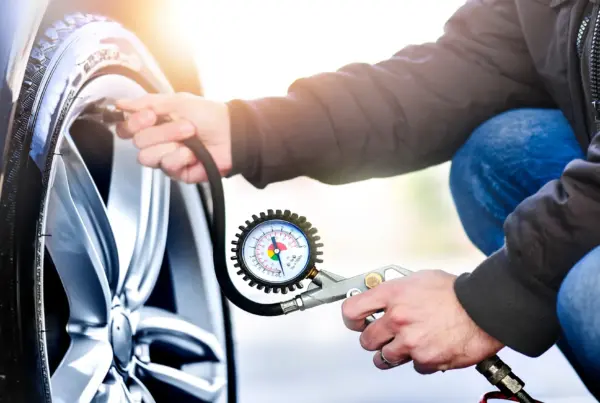
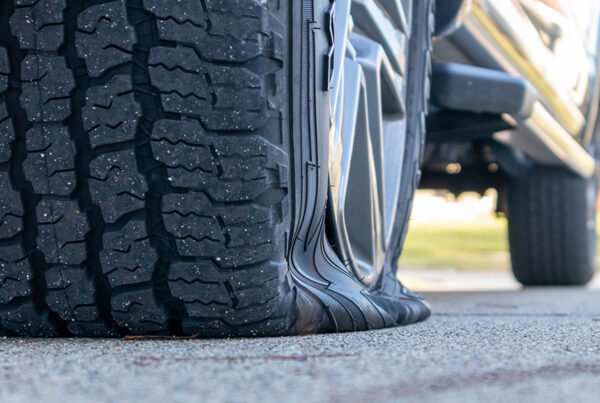
The tire that lost air quietly over the winter is the one that fails on the first hot haul of the season. Underinflated trailer tires are more prone to damage and generate excess heat that leads to internal structural damage. The tire flexes more than it was designed to, the temperature climbs, and the belts start separating from the inside where you cannot see it.
That contractor’s enclosed job trailer running loaded between Gainesville, Sanger and Denton five days a week is the classic case. It never gets a pressure check because it never gets parked long enough for anyone to think about it, and at highway speed a soft tire heats up fast. Always check pressure cold, before the trailer has been towed, and check every position including the spare. Our post on why proper tire pressure matters for safety and performance covers the fundamentals that apply here too.
- Check pressure cold, not after a run down the highway
- Check the spare, which is the position everyone forgets
- Air loss between trips is a symptom, not a nuisance
How to read the DOT date code on a tire you already own
This is the single most useful habit for a trailer owner, and it takes about a minute. Every tire sold in the U.S. carries a Tire Identification Number on the sidewall that begins with the letters DOT. The final four digits give you the build date: the first two are the week of manufacture, running from 01 through 52 or 53, and the last two are the year.
So a code ending in 2119 means the twenty-first week of 2019. Read that against today’s calendar and you know exactly how old the tire is, regardless of how many miles it has covered. This is a check you run on the tires already bolted to your trailer, not just on tires you are shopping for. The date code is often stamped on the inside sidewall, so you may need to crouch and look at the back face of the tire.
- Check all four positions, plus the spare under the tongue
- Tires bought at the same time can still have different build dates
- Write the dates down somewhere so you are not re-checking every spring
What the numbers mean once you have them
There is no single federal rule that forces a trailer tire off the rim at a set age. Common practice is to plan on replacement around five to six years for a work trailer that earns its keep, and to treat ten years as an outside limit that nothing should pass.
Keep in mind that mileage and calendar age do not cancel each other out. A seven-year-old tire with almost no miles on it can absolutely need replacing, and a four-year-old tire in heavy service can already be worn out. The USTMA makes a related point: calendar age matters most on tires that do not accumulate mileage, like full-size spares and seasonal or occasional-use vehicles. A boat trailer is exactly that.
- Under five years with clean sidewalls: keep inspecting monthly
- Five to six years: start planning tire replacement in Cooke County before the busy season
- Past ten years: replace, no matter how the tread looks
The five-minute pre-haul inspection
Before you load hay, hook up the boat or head out with the job trailer, walk the tires. A good inspection checks every tire cold including the spare, looks over the sidewalls for cracks, cuts, scuffs, bulges and exposed material, checks the tread for minimum depth, embedded objects, flat spots and cupping, and confirms the DOT manufacture date.
Then add two habits for the road. After the first few miles, pull over and put the back of your hand near each hub. A hub that is noticeably hotter than the others points to a bearing or brake problem that will cook the tire from the inside. And check your lug nuts, especially on a trailer that has recently had wheels off.
- Sidewalls: cracks, crazing, bulges, exposed cord
- Tread: depth, nails and screws, flat spots, uneven or cupped wear
- Hubs: uneven heat after the first few miles
- Lug nuts: tight and torqued evenly
Signs a trailer tire is about to let go
The USTMA notes that increased air loss, noise or vibration can signal internal damage that needs immediate professional inspection. On a trailer you feel those symptoms through the tow vehicle, and they are easy to write off as road surface or a rough load. Do not. If a tire has already picked up a puncture, our post on tire plug vs. tire replacement explains when a repair is safe and when it is not.
If a trailer tire comes apart at speed on Hwy 82 heading toward Whitesboro, the tread can damage the fender, the wiring and sometimes the brake line. The repair afterward is usually more disruptive than the tire would have been. If you want to know what your options are before it gets to that point, contact us for a current quote rather than guessing.
- A bulge anywhere on the sidewall means stop now
- Losing air between trips is an internal problem, not a slow valve
- New vibration or noise while towing deserves a look the same week
Nobody is checking your trailer for you anymore
One more thing worth knowing locally. As of January 1, 2025, non-commercial vehicles in Texas no longer need a vehicle safety inspection before registration. Commercial vehicles are unaffected and still require a passing safety inspection, and the state continues to recommend regular maintenance so brakes and tires keep working properly.
For a private hay trailer, boat trailer or utility trailer, that means the only set of eyes on those tires now belongs to you, or to the shop you choose. There is no annual checkpoint catching a dry-rotted sidewall on your behalf. Building your own inspection habit is what replaces it.
Visit Casey’s Tire & Brake for trailer tires in Gainesville, TX
You should not have to guess whether the tires on your trailer are still safe. Bring the trailer to our tire shop in Gainesville, TX and we will read the date codes, check the load range against what you actually haul, inspect the sidewalls and pressures, and tell you plainly whether you have another season or need new rubber now. If it is time for replacement, we will walk you through the right ST tire for the way you use the trailer.
If you want to know what a set will run for your trailer, request a current quote and we will give you real numbers for your size and load range. You can also schedule an appointment and we will look the whole trailer over before your next haul.